There is nothing quite like falling in love with a crochet photo, buying the pattern in a rush, and then finding instructions that do not make sense at all. Learning how to spot fake crochet patterns before you buy can save your yarn, your weekend, and your confidence — especially if you are buying a pattern as a gift, or choosing your first few projects.
Quick disclosure: we run KnotBloomStudio, the small pattern shop linked at the end of this guide. We mention it as one shop we can vouch for from the inside, not as the only good shop out there. The checks below will help you judge any seller, including us, fairly.
Fake patterns are not always obvious scams. Some pair computer-generated pictures with untested instructions. Others reuse a real designer’s photos without permission. You do not need to be an expert to catch most of them — just a calm, two-minute routine before checkout.
Use this guide as a checklist. One warning sign alone does not prove a pattern is fake: new designers can have small shops and no reviews yet. But when two or three signs stack up, walk away.
1. How to spot fake crochet patterns in photos: zoom in first
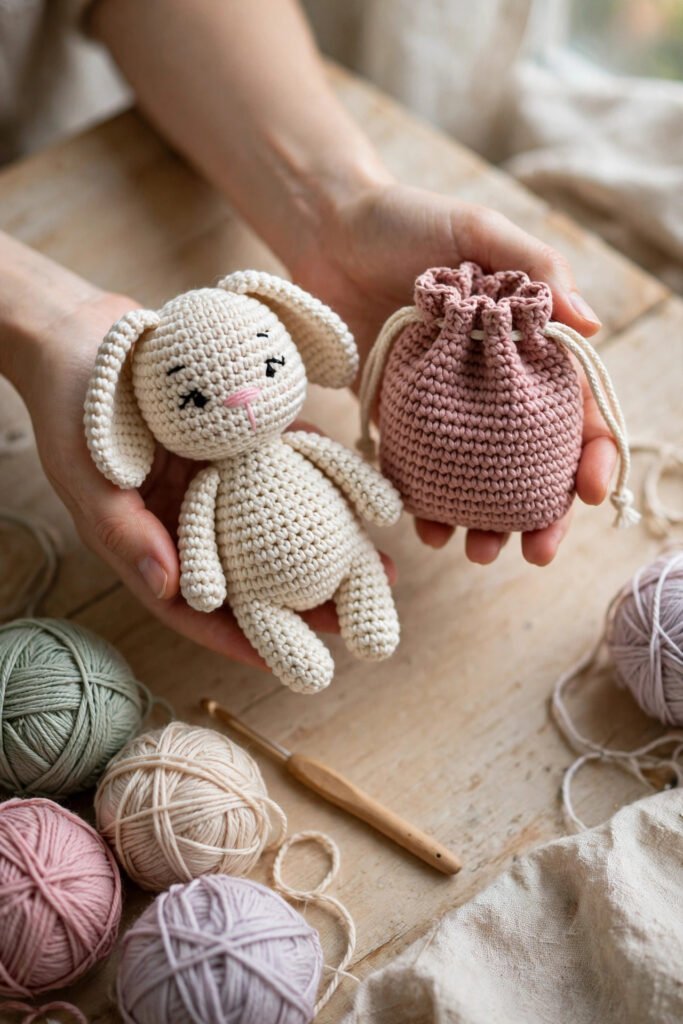
Real crochet has texture. You should be able to see individual stitches, slight unevenness where a hand changed tension, and soft shadows in the fabric. If every photo looks glossy, impossibly smooth, and more like a catalogue illustration than something made with yarn, look closer.
Zoom in on the stitches. Do they repeat regularly, or do they blur, melt into each other, and change direction for no reason? Then swipe through every photo. In a genuine listing, the same item appears from different angles — front, back, side, and close-up — and its colour, size, and stitch pattern stay the same. If a detail appears in one photo and vanishes in the next, that is a strong warning sign.
Practical tip: Zoom to 200% on one close-up and ask, “Can I name the stitch I am looking at?” If you cannot see any recognisable stitch at all, do not buy yet.
2. Check that the stitches in the photo match the words
A trustworthy listing tells one consistent story in pictures and in text. If the description says a bag uses a lacy, open stitch, the photos should show open, lacy fabric — not dense, solid fabric. If it promises colourwork, it should explain how the colours change. If a finished size is given, the item in the photos should look roughly that size.
This is where many fake listings fall apart: the picture shows one kind of fabric, the title promises another, and the description says almost nothing about either. A real designer knows which stitches they used, because they chose and tested them. You only need to check for consistency.
Practical tip: Read the title, look at the main photo, then read the first paragraph of the description. If those three do not describe the same item, skip it.
3. Read the materials list like a shopping list
Before you buy yarn, you should be able to answer a simple question: what exactly do I need? A real pattern listing normally states the yarn weight, the approximate yardage or number of skeins, the hook size in millimetres, the finished measurements, the skill level, and anything special, such as safety eyes or buttons.
Fake listings often skip this list, or fill it with words that do not help you shop: yarn described only as “soft yarn,” no hook size, no finished size, or measurements that do not fit the photo. Vague is not the same as beginner-friendly — beginner-friendly means clear, not empty. Gauge matters most for anything that must fit, such as hats and garments.
Practical tip: Before checkout, write down the yarn weight, hook size, and finished size from the listing. If you cannot fill in all three, message the seller or choose another pattern.
4. Do the stitch-count maths on one row or round
This is the most useful test in this guide, and it takes less than a minute. Real patterns give a stitch count at the end of rows or rounds so you can check your work as you go. Fake or untested patterns often leave counts out, repeat instructions that cannot add up, or tell you to “repeat until desired length” with no target at all.
You do not need to work through the whole pattern before buying. If a preview or sample shows even one shaped row, read it slowly. If a round starts with 24 stitches and the instructions add six increases, the next round should end with 30 stitches. If the numbers jump, contradict themselves, or simply stop appearing, the pattern was probably never made from start to finish. Also look for plain explanations: special stitches defined, US or UK terminology stated, and joins noted.
Practical tip: Pick one increase or decrease row you can see before buying and check its maths. If the count does not work, believe the maths, not the photo.
5. Read the listing copy — and the reviews — properly
Polished marketing language alone does not prove a pattern is fake; real designers use it too. What matters is whether the copy says anything specific. Does it name the stitches, sizes, and contents of the PDF? Does it say how many pages it has, whether it includes photos, and what skill level it suits? Or does it repeat the same cheerful phrases — cosy, adorable, perfect for everyone — without ever getting concrete?
Reviews need the same careful reading. Do not stop at the star rating. Read the actual words, especially the earliest reviews. Repeated comments about unclear instructions, a finished item that does not match the photo, or counts that do not work are far more telling than short, generic five-star reviews. Also be wary of shops selling almost nothing but enormous bundles — hundreds of patterns for a tiny price, with no consistent style.
Practical tip: Scroll to the oldest reviews first and read five of them in full. If the earliest buyers struggled, later praise does not erase that.
6. Vet the seller, not just the single listing
A pattern is only as trustworthy as the shop behind it. Before buying from an unfamiliar shop, spend one minute checking who is behind it. A real designer usually leaves a trail: a shop bio in a personal voice, other listings in a recognisable style, a social page or website showing work in progress, and answers to buyer questions.
That trail does not need to be large — a new designer may have only a few listings, and that is fine. What should give you pause is a shop with no trail at all: a generic bio and dozens of unrelated designs in wildly different styles. Search the shop or pattern name outside the marketplace; if the same photos appear under a different designer’s name, buy from the original maker.
Practical tip: Search the shop name plus the pattern name. A real designer usually appears in more than one place; a copied listing often appears under more than one seller.
7. Watch for the classic AI-fake tells
Some generated images are now very convincing at a glance, so know the details where they still slip. Look closely at hands, if any are shown: extra fingers, fingers that bend the wrong way, or a hand holding a hook in a way no crocheter would. Look at backgrounds too: blurred or smudged rooms, objects melting into table tops, and shadows falling in different directions.
Also ask whether the project could actually exist. A life-size crochet car, an animal with extra limbs or painted-on whiskers, or colours no yarn could produce — those are pictures, not patterns. And a beautiful photo on Pinterest or Facebook is not a pattern: if the link leads nowhere, asks only for your email, or promises a “free secret PDF” that turns into a paid listing from a stranger, close the tab.
Practical tip: If a project looks too perfect, too huge, or too detailed to be real, compare it with a finished project you have made. Real crochet has limits, and those limits are part of its charm.
8. What to do if you already bought a fake pattern
First, do not blame yourself. These listings are designed to look convincing, and even experienced crocheters have been caught out. Stop before you buy yarn for a pattern that does not add up, and keep the listing link, the PDF, and any messages with the seller.
Message the seller calmly and specifically, naming the row that does not work. Many marketplaces, including Etsy, have a window for raising a problem with a digital download, so check the order page promptly. If the seller does not respond, use the report or case process and leave an honest, factual review. If the listing used a real designer’s stolen photos, consider sending that designer the link.
Practical tip: Screenshot the listing and save the PDF before anything disappears. You will need both if you open a case or report the shop.
9. A safer way to buy your next pattern
You do not need to become a detective for every project. Build a small rotation of designers you trust, start with small projects when trying a new shop, and run the checks in this guide before you spend on a larger pattern. Small, quick makes are a kind, low-risk way to test a new designer: a soap saver, a face scrubby, or a simple beginner gift will quickly show whether the instructions are clear and the counts work.
For gentle first projects, browse our easy crochet gift ideas for beginners, try a practical crochet soap saver, or start with reusable crochet face scrubbies — all small makes where a clear pattern, a sensible materials list, and a checkable finished size matter more than a perfect photo.
Make it: Choose a pattern from a designer you have vetted with the checks above, or start with a KnotBloomStudio PDF, where the materials, stitch counts, and finished size are stated up front so you can check them before you begin.
Buy it ready-made: If you love the look but do not want to make it yourself — especially for a gift — browse finished pieces at KnotBloomStudio on Etsy. Buying ready-made removes the pattern risk entirely, and you can still judge the shop the same way: real photos, consistent style, and clear descriptions.
Practical tip: Save this guide and run the same checks on your next three pattern purchases. By the third, the routine will feel automatic, and the fakes will stand out in seconds.
What is the fastest way to tell if a crochet pattern is fake?
Zoom in on the photos first. If you cannot see clear, repeating stitches, the details change between photos, and the listing gives no yarn weight, hook size, or finished size, treat it as a warning — especially if the stitch counts do not add up either.
Are all AI-generated crochet images a scam?
No. A clearly labelled illustration beside a real, tested pattern is not a scam. The problem is an unlabeled generated photo presented as a finished, makeable item, paired with instructions that were never tested.
Can a new designer with no reviews still be trustworthy?
Yes. Small shops and new designers are normal. Look for a personal bio, a consistent style across listings, clear materials and counts, and answers to buyer questions — one missing signal alone is not proof of a fake.
What should a real crochet pattern listing always include?
At minimum: yarn weight and yardage, hook size in millimetres, finished measurements, skill level, stitch counts at the end of rows or rounds, and whether it uses US or UK terminology.
What should I do if I already bought a fake crochet pattern?
Save the listing link and PDF, message the seller naming the exact row or problem, check the marketplace’s case window promptly, and leave an honest, factual review so the next buyer can spot the problem before buying.